
Wazoo In Effigy
album
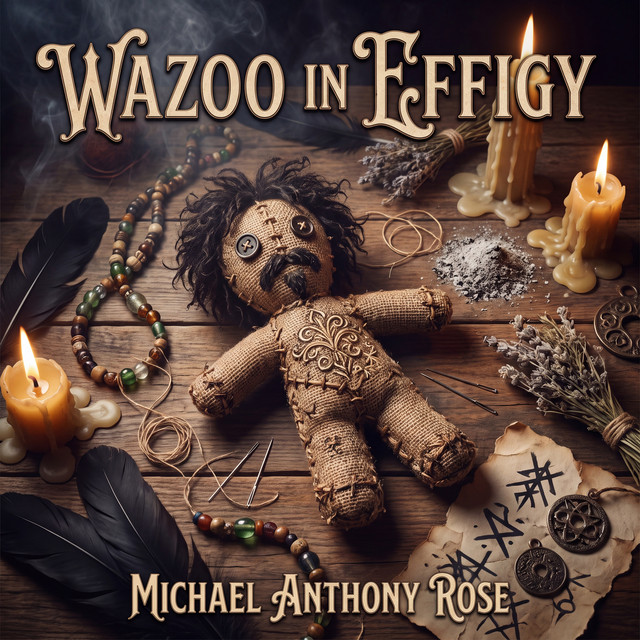
Wazoo In Effigy
Michael Anthony Rose’s Wazoo in Effigy is inspired by Frank Zappa, which is not quite the same thing as being a Zappa tribute. Rose borrows some of the machinery - abrupt meter changes, marimba and percussion ostinatos, jazz-rock ensemble writing, spoken absurdism, ugly-pretty harmonies, doo-wop mutations, instrumental passages that sound dangerously close to coming apart - but he is less interested in reproducing Zappa’s music than in seeing what can still be built with some of the ideas behind it.
That turns out to be the album’s strongest decision. An imitation of Zappa would have been doomed from the first bar. Instead, Wazoo in Effigy treats him almost as a permission slip: permission to let a joke become an argument, to interrupt a song with an instrumental problem, to make virtuosity funny, to make stupidity complicated, and to refuse the assumption that sophisticated music must behave seriously.
Across the record, Rose repeatedly sets ordinary human foolishness against unnecessarily elaborate musical architecture. Language slips. Symbols refuse to mean exactly what we think they mean. Bodily functions acquire philosophical significance. Tools promise impossible cures. Social rules collide with animal instincts. Musical structures become part of the joke rather than merely accompaniment to it. Some pieces land immediately; others feel deliberately overbuilt, with arrangements that demand more attention than their premises initially seem to deserve. That imbalance is occasionally frustrating, but it also belongs to the record’s character. Wazoo in Effigy likes excess too much to pretend otherwise.
What holds the album together is curiosity rather than impersonation. Rose seems fascinated by the point where equivalence becomes approximation, dignity becomes ridiculousness, expertise becomes pomposity, and a perfectly defensible idea gets pushed one step beyond where good manners would have stopped it. The humor frequently comes from refusing to stop.
That makes the title track an important ending, but not because the preceding album has been building toward a demand that Frank Zappa be declared a misunderstood genius. “Wazoo in Effigy” is darker than that. After spending an album exercising some of the freedoms Zappa helped establish, Rose turns toward the price an artist can pay for exercising them.
The song is structured as an accumulation of judgments. Wazoo is arrogant. Academic. Vulgar. Difficult. Cheap with musicians. Emotionally barren. Perhaps brilliant, but unpleasantly aware of it. Rose does not systematically rebut those charges. Instead, Wazoo answers: “I wrote what I heard. / I said what I saw.” The distinction between explanation and exoneration is crucial. The song asks what becomes of criticism when the qualities being condemned are inseparable from the qualities that produced the work.
Even its historical punch line refuses to resolve the matter. A famous detractor eventually stands onstage honoring the man he once dismissed, yet “no correction was printed.” The point is not that critics were stupid and Zappa was right. It is that judgments harden while the work keeps moving.
That is a far more interesting place for Wazoo in Effigy to end.
Rose has made an album clearly indebted to Zappa without turning indebtedness into cosplay. At its best, the record understands that the useful inheritance was never a particular guitar tone, joke, meter or marimba part. It was the larger proposition that popular music could contain almost anything if the composer could make the pieces hold together.
Sometimes Wazoo in Effigy barely holds together.
That may be the compliment it was looking for.
Tracks